
Private Burgundy Wine Tours: Tailor-Made Wine and Terroir Experiences
Burgundy is one of the oldest wine destinations in the world, and probably the one where the idea of terroir has been taken furthest: here, people do not talk about a region but about climats, plots mapped out since the Middle Ages and listed as a UNESCO World Heritage Site. This is not a vineyard to rush through: a wine and food tour in Burgundy unfolds cellar by cellar, table by table.
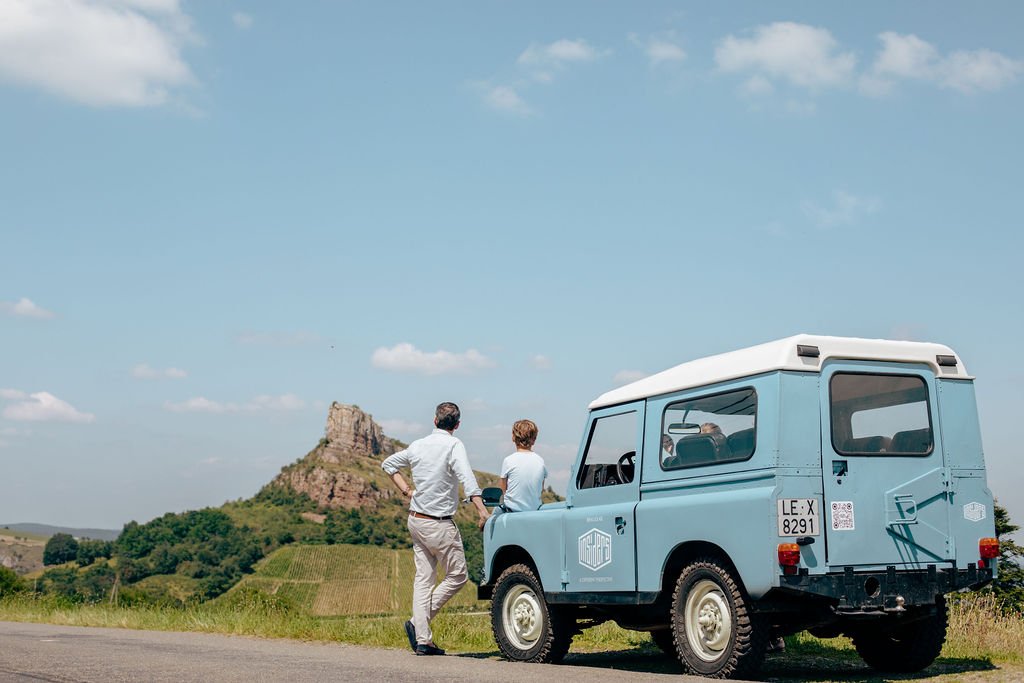
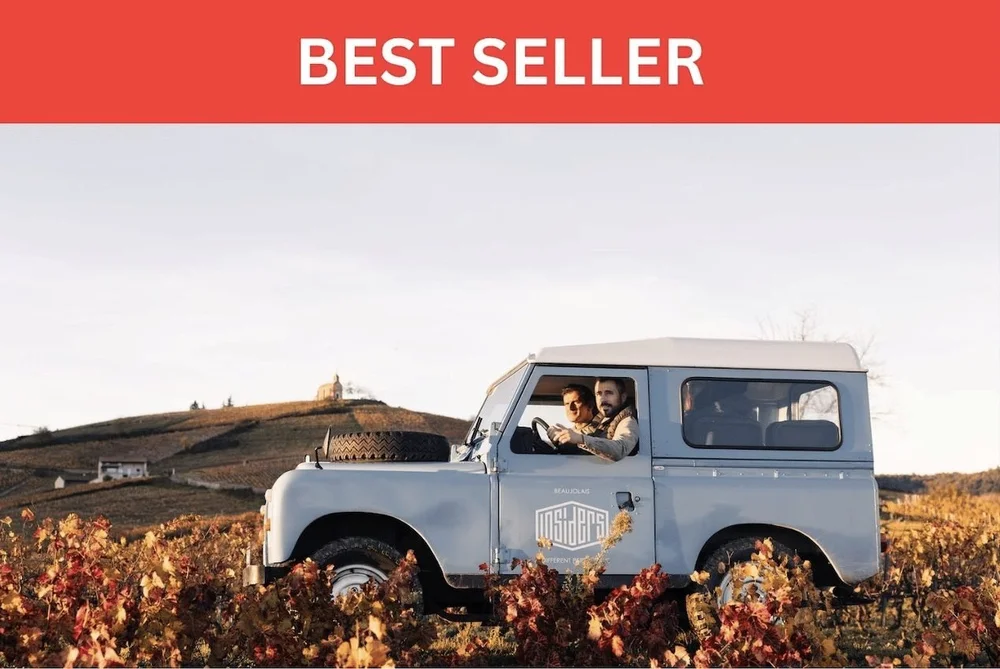
Our tours take you to its southern part — the Mâconnais and neighbouring Beaujolais — aboard a vintage Land Rover or Range Rover, to winemakers who are usually unknown to the general public. These are private tours in the strictest sense: your group, your Insider, your pace, and nobody else in the car.
Our four wine and food tours in Burgundy
 Full day
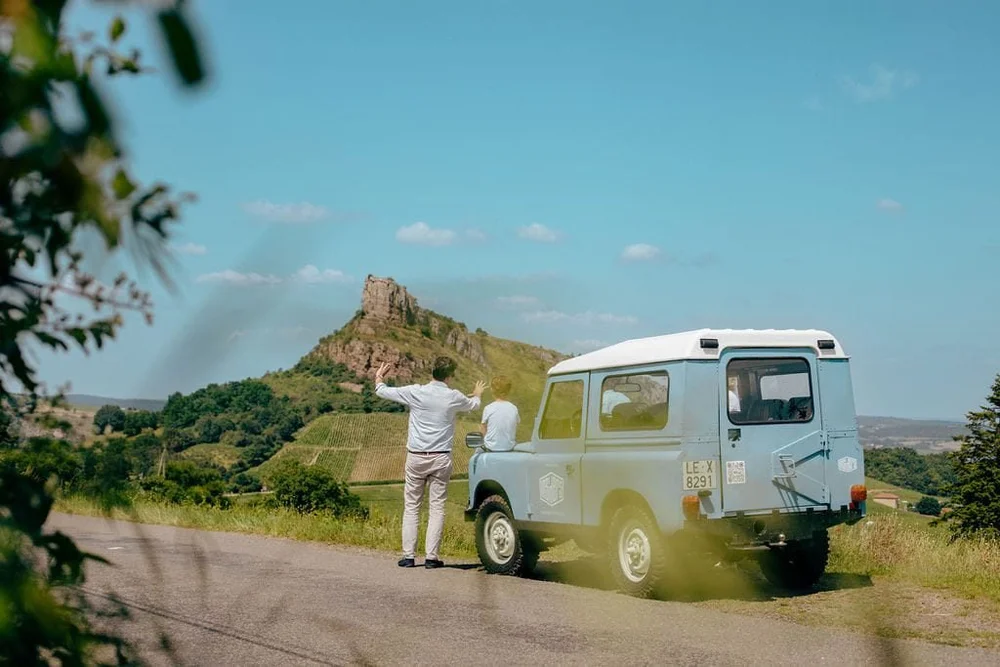
Southern Burgundy Food & Wine Tour
Less than an hour from Lyon, the Mâconnais fits into a few kilometres of hillsides.
- Full day — 8 h
- 4 wine estates
- Lyon or Mâcon
From 995 €
 Half day
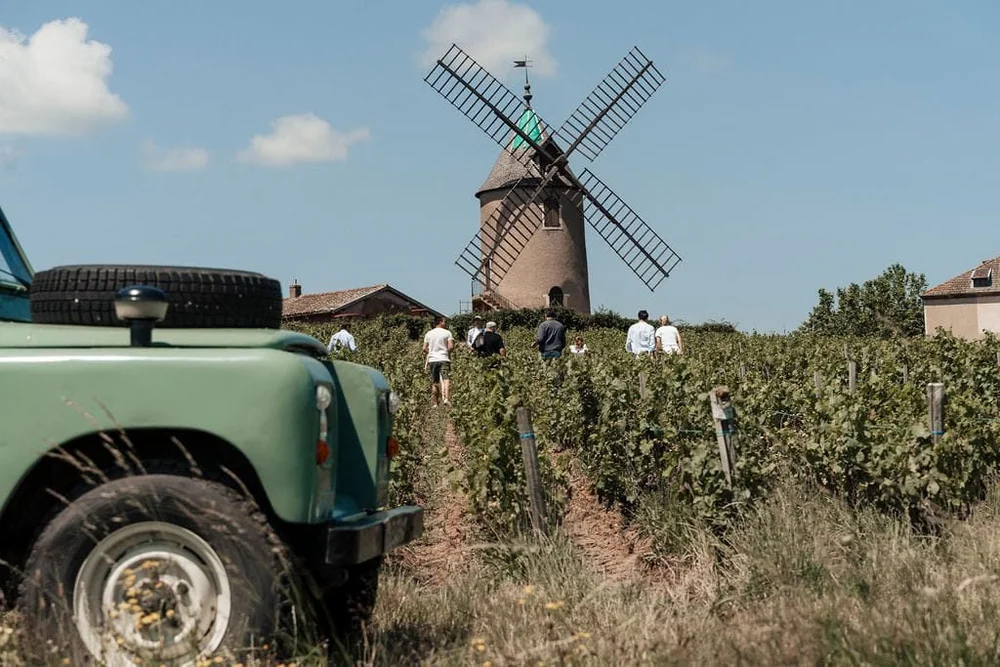
Burgundy Wine Tour: Vineyard Visits & Wine Tasting
A morning is enough. Time to climb into the hills of the Mâconnais, go down into two cellars, understand why a Pouilly is nothing like a Mâcon-Villages, and be back in Lyon before lunch.
- Half day — 4 h
- 2 wine estates
- Lyon or Mâcon
From 460 €
 Full day
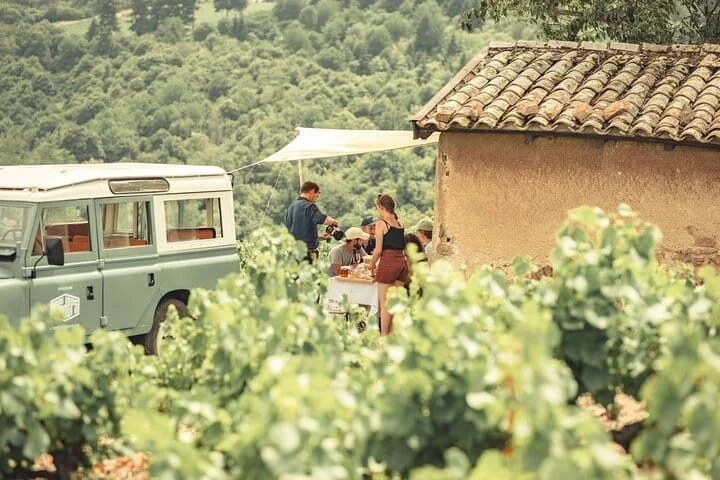
Burgundy & Beaujolais Food & Wine Tour
Two vineyards touch and have nothing in common: gamay on granite on one side, chardonnay on limestone on the other.
- Full day — 8 h
- 2 to 4 wine estates
- Lyon
From 995 €
 Full day
Winter Food & Wine Tour in Burgundy and Beaujolais
In winter, the vineyard lets its guard down.
- Full day — 8 h
- 3 wine estates
- Beaujolais
- Autumn and winter
From 967 €
The price shown is the package for two people, with a supplement per person from the third traveller. The exact amount, available dates and booking are in each tour's calendar.
Wine tours to discover the vineyards and climats of Burgundy
The Burgundy vineyard stretches for almost 230 kilometres, from the Yonne to the gates of Lyon. It is made up of five main areas, and each calls for a different kind of tour — the grand crus, the vineyard roads, the family estates of the south. Knowing which one matches what you are looking for is the first decision to make.
The Burgundy of the grand crus
Chablis opens the vineyard in the north, with mineral whites grown on a soil of fossilised oysters. Further south begins the Côte-d'Or, the most famous strip of vines in the world: the Côte de Nuits around Nuits-Saint-Georges for Pinot Noir reds, then the Côte de Beaune, where Meursault, Puligny-Montrachet and Santenay produce benchmark whites.
Beaune is its wine capital, with its Hospices, its négociant cellars and its Burgundy Wine Museum; Dijon closes the vineyard to the north, with its International City of Gastronomy and Wine. This is prestigious Burgundy — magnificent, very busy, and increasingly closed to intimate encounters: the most sought-after estates no longer open their doors, or open them at a price that has little to do with a tasting.
Southern Burgundy, where doors still open
South of Chagny, the Côte Chalonnaise and then the Mâconnais change scale. Same grape varieties, same know-how, but family estates of a few hectares where the winemaker takes you down to the cellar in person. Bottle prices bear no relation to those of the Côte-d'Or, and the quality is often remarkable.
This is where we chose to work, for a simple reason: these are the only places where you can still spend two hours with someone who pruned their vines that very morning. Our full-day wine tour in Southern Burgundy is the most complete way to experience it.
Mâconnais wines, from Mâcon-Villages to Pouilly-Fuissé
The Mâconnais is the kingdom of Chardonnay. Across some fifty kilometres of limestone slopes, it produces whites ranging from the most straightforward to the most finely chiselled: Mâcon-Villages for approachability, Saint-Véran for precision, Pouilly-Fuissé for depth — the latter appellation having had its first climats classified as premier cru, which changed the way the whole area is seen.
There are also a few reds from Gamay and Pinot Noir, and a production increasingly turned towards organic and biodynamic farming. Most houses are family-run: when you visit the cellar, you talk to the person who makes the wine, not to a sales team. That is the tasting we go looking for, explained by the person who made the wine.
Burgundy road trip: the Route des Grands Crus and the vineyard roads
Burgundy lends itself to a road trip better than almost any other French wine region: distances are short, the roads are beautiful, and three signposted routes follow one another from north to south. Here is what they are worth — and what they cannot replace.
The Route des Grands Crus, from Dijon to Santenay
One route alone carries the region's tourist reputation. Some sixty kilometres, around thirty villages whose names appear on the most expensive labels in the world: Gevrey-Chambertin, Vougeot and its château, Vosne-Romanée, Nuits-Saint-Georges, Aloxe-Corton, Pommard, Meursault, Puligny-Montrachet. It is the backbone of French wine tourism, and probably the most iconic road trip you can take in France behind the wheel. It can also be ridden by bike: the Voie des Vignes runs alongside the road between Beaune and Santenay.
The other vineyard roads
South of Chagny, the Route Touristique des Grands Vins crosses the Côte Chalonnaise — Rully, Mercurey, Givry — then the Mâconnais-Beaujolais wine route runs down to the gates of Lyon. End to end, these routes make a three- to four-day road trip, with their châteaux, abbeys, village museums and houses of golden stone. Allow at least two nights if you want to stop anywhere other than the tasting rooms that post their opening hours by the roadside.
What a road trip will not give you
The landscapes, the tasting rooms, the great names lined up over a few kilometres: a road trip gives you all of that, and very well. What it does not give you is the winemaker's door — the door of estates that have no tasting room, no opening hours and no sign by the road. Our itineraries cross these roads without following them: we take them for their most beautiful stretches, then turn off. For wine lovers who want both, the right approach is to combine them — the route on your own one day, the Mâconnais with an Insider the next. And one detail that matters: on a road trip, someone has to stay sober.
Food tour: the table, the cheese and the mâchon
A wine tour that stopped at the glass would miss half the region. In Burgundy, wine only makes sense at the table — and the table here has its own monuments.
The Burgundian table
Snails, jambon persillé, œufs en meurette, bœuf bourguignon, Dijon mustard, Époisses and the other cheeses of the Auxois: Burgundy's culinary specialities form one of the most recognisable regional repertoires in France, and every one of them is meant to be paired with a specific wine. Our full days stop at village restaurants — the ones the winemakers go to themselves when they are not receiving guests — or set up a picnic among the vines, your choice at booking.
Producers, priories and distilleries
A food tour in Burgundy also means meeting the producers. A goat farm set in a former Cluniac priory, itself built on a Celtic site, whose cheese is sold only on the premises. A family distillery of Burgundian spirits, on the winter tour. And the mâchon — the traditional morning snack of charcuterie, cheese and a glass of wine — which remains the local institution least known to visitors.
Heritage comes along in the same breath: the Rock of Solutré, which gave its name to an entire period of prehistory, and the legacy of Cluny, whose abbey was the largest church in Christendom and which scattered Romanesque buildings across the region.
Discovering Burgundy: what you see here and nowhere else
Each day is built with your Insider, and no two are ever the same. Here are some of the places where we take our travellers — as examples, to give you an idea of what Southern Burgundy keeps to itself.
- A cellar founded by eighty winemakers. Eighty Mâconnais winemakers joined forces to open a shared tasting venue. You can taste up to eight wines there, giving you in a single stop an overview no single estate can offer.
- The Rock of Solutré, and the story it tells. The promontory overlooks the whole vineyard and can be climbed on foot. François Mitterrand went up once a year to pay tribute to the Resistance fighters: it has become a place of remembrance as much as a viewpoint.
- An estate handed down from mother to daughter. This one passes down through the women of the family, and most of its team is female — still rare in the wine world. The person who makes the wine explains the winemaking process, from start to finish.
- A wine château in Fuissé, since the 19th century. The village gave its name to the most renowned appellation of the Mâconnais. Here you step into a château that makes its own wine and has belonged to the same family since the 19th century — the owner welcomes you in person.
- The cheese sold only in the farmyard. A goat farmer based in a former Cluniac farm sells his cheese nowhere but at home. No market stall, no shop, no shipping: you have to come.
- A Romanesque church painted by hand over thirty years. Its priest devoted three decades, in the early 20th century, to covering the walls with frescoes. The result appears in no brochure, and you will usually have the place to yourselves.
- A forest inhabited by fairies. The road crosses a wood that local lore says has residents. We cannot guarantee a fairy during the tour — it is about the only thing we do not guarantee.
Private estate visits: what a private tour changes
Doors that would not open otherwise
Most of the estates on our route have no tasting room, no opening hours and no booking website. They welcome you because our Insider knows them personally, often for years. That is the practical difference between a private visit and a tasting-room tasting: in the first case, you walk into someone's home; in the second, you walk into a shop.
A driver, and no steering wheel for you
Your Insider drives. That is what makes the tasting a real one, and what sets our private tours apart from a wine route driven on your own. The vehicle is reserved for your group, and the itinerary adapts along the way: a detour to a forgotten chapel, a longer stop at a winemaker's because the conversation is getting interesting. None of our days ever unfolds exactly like the one before.
Planning your wine tour in Burgundy
A few pointers before you build your programme — whether you are coming for a day, a weekend in Burgundy or a trip that links several wine destinations.
How much time to allow
Duration is the first variable, and the one that changes everything else. A half-day is enough for a first approach and two estates. Allow a full day to really understand a terroir and add a meal, and two to three days if you want to explore several vineyards. Beyond four estates a day, the palate can no longer keep up — that is a physiological limit, not a matter of organisation.
When to come
May to June for the landscapes and the mild weather; September for the buzz of the harvest, even though winemakers are very busy then; autumn for the colours. Winter remains the most underrated season: the vines are bare, the cellars are full, and it is when people give you the most time.
Where to stay
Mâcon and Cluny offer the best balance between access to the vineyards and town life: town-centre hotels, a railway station, restaurants open in the evening. The surrounding wine villages offer guest houses and winemakers' homes, often right among the vines. Lyon remains a comfortable base: less than an hour's drive, and all our tours depart from there, with Lyon ⇄ Mâcon train tickets included.
Our tips to make the most of it
Do not drive. Wear closed shoes: the cellars are cool and the farmyards uneven. Tell the winemaker what you like rather than waiting: they will open other bottles. Book your table at the same time as the vineyard — the good village restaurants are small. And keep some room in the boot.
Why book your private wine tour with Insiders
Our tours are led by Insiders who live here and know personally the winemakers they take you to. No visit is standardised: itineraries adapt to your wishes as the day goes on, and two departures in the same month never make for the same experience. That is the difference between driving a wine route and being introduced to a vineyard.
We design and run our own tours — we resell nothing. Book the tour of your choice above, or write to us for a tailor-made wine and food stay.
Frequently asked questions
What is a wine and food tour in Burgundy?
It is a day that brings together the two halves of the region: estate visits and guided tastings on one side, the table and the producers on the other — cheesemaker, village restaurant, mâchon, distillery depending on the itinerary. All four of our tours combine both; only the half-day focuses on wine.
What is the best wine tour in Burgundy?
It depends on how much time you have and what you are looking for. For the grand crus and the heritage, the Côte-d'Or between Dijon and Beaune is the obvious choice. For meeting winemakers and reasonable prices, the Mâconnais and the Côte Chalonnaise are more generous: that second Burgundy is the one our private tours cover, as a half-day or a full day.
Can you do the Route des Grands Crus as a road trip?
Yes, and it is even the best way to see it: from Dijon to Santenay, the route can be followed freely, by car or by bike. You simply need to know what a road trip will give you — tasting rooms, châteaux, villages, museums — and what it will not: a cellar opened by the person who filled it. Our days take place further south, for exactly that reason.
Are your tours really private?
Yes. Every departure is reserved for your group: nobody else in the vehicle, nobody else at the tasting. That is what makes it possible to enter estates that do not receive the public and to adapt the itinerary along the way.
When is the best time for a wine tour in Burgundy?
Spring and summer offer the landscapes and outdoor tastings; autumn, the colours and the buzz of the harvest. Winter is the most underrated season: winemakers are no longer out in the vines and genuinely take their time — which is the whole point of our winter tour.
Where do the tours start and how do I book?
Most leave from Lyon, with return Lyon ⇄ Mâcon train tickets included in the price and sent in advance; a private car transfer is available as an option. You can also join us directly in Mâcon, whose TGV station is 1 h 40 from Paris. Booking is done online from each tour's page, or by phone.
What does a cellar visit and tasting include?
Visits to estates and cellars, guided tastings — from four to sixteen wines depending on the tour —, meetings with winemakers, private transport with a driver and, on full days, lunch. Depending on the itinerary, heritage stops are added: Romanesque chapel, priory, château, producers' farm.
Should I choose the half-day or the full day?
The half-day covers two estates in four hours and fits into a busy schedule. The full day doubles the number of stops, adds the food dimension — lunch, cheesemaker, producers — and opens up the more confidential places. For a first visit, it is the one that will give you the most.
Can I buy wine during the tour?
Yes, directly from the winemakers, with delivery possible in France and abroad. It is often the best way to leave with bottles you cannot find anywhere else.
Can you build a tailor-made tour?
Yes. Write to us at thomas@insidersexperience.com or call +33 6 98 78 29 28: we build the itinerary with you, for a single day or several.