
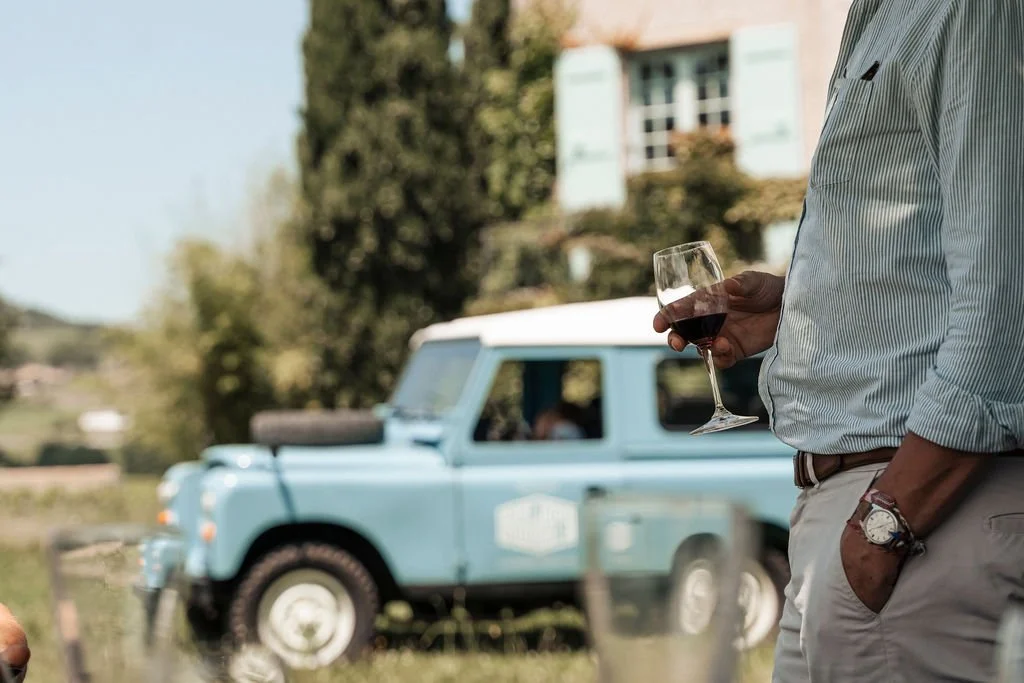
Private Beaujolais wine tours: vineyards, terroir and tailor-made tastings
Beaujolais is the rural France people go looking for without always finding it: charming villages and monuments spared by the crowds, more than 3,000 winemakers, and a welcome that has stayed genuine. The vineyard begins thirty minutes from Lyon and nobody goes there — which is precisely what makes it our playground.
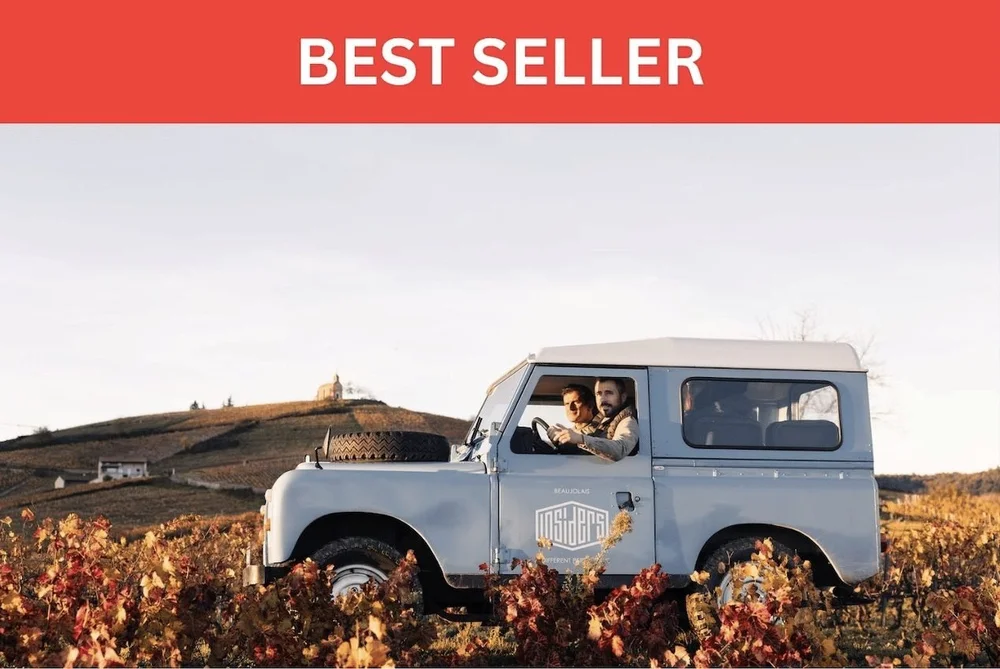
Our tours take you into the northern hills, aboard a vintage Land Rover or Range Rover, to the heart of the crus — the vineyard's finest terroirs, and your Insider will explain why — and into cellars the general public rarely gets to know. Cellar tour, an insight into the winemaker's craft, tastings of the crus, a mâchon or a winemaker's lunch: a wine and food tour in Beaujolais works as a half day or a full day, always private and always departing from Lyon.
Our four wine and food tours in Beaujolais
 Full day
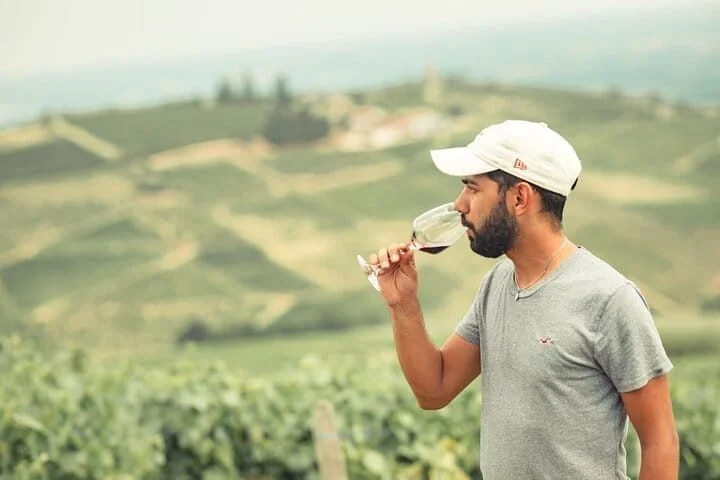
Beaujolais Food & Wine Tour
Ten crus, granite hills, and forty years of misunderstanding to clear up.
- Full day — 8 h
- 2 to 4 wine estates
- Lyon
From 980 €
 Half day
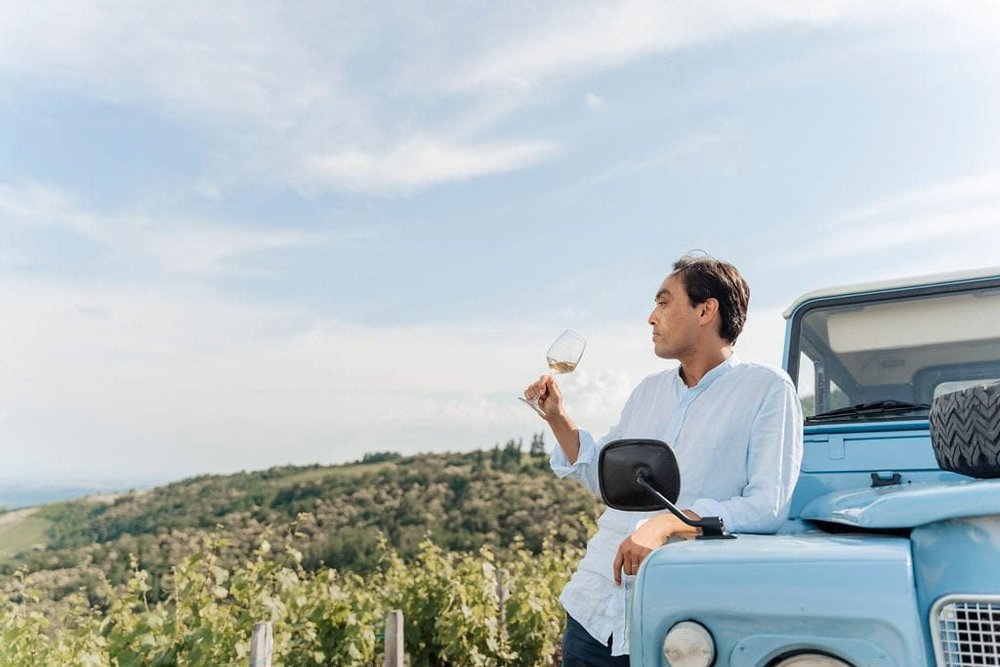
Beaujolais Wine Tour: Vineyard Visits & Wine Tasting
Thirty minutes from Lyon, and the hills begin. Four hours to push open two gates that stay closed to the public, go down into the cellars of the northern crus, and taste between the rows if the sun joins in.
- Half day — 4 h
- 2 wine estates
- Lyon
From 440 €
 Half day
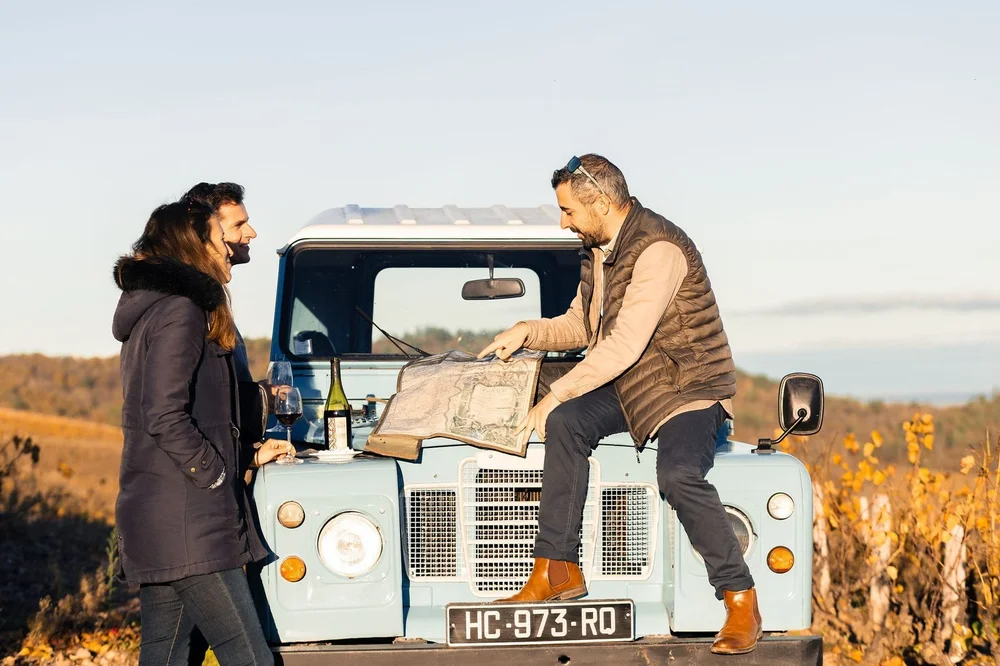
Winter Food & Wine Tour in Beaujolais
Once the third Thursday of November has passed, Beaujolais becomes itself again.
- Half day — 4 h
- 2 wine estates
- Beaujolais
- Autumn and winter
From 395 €
 Full day
Winter Food & Wine Tour in Burgundy and Beaujolais
In winter, the vineyard lets its guard down.
- Full day — 8 h
- 3 wine estates
- Beaujolais
- Autumn and winter
From 967 €
The price shown is the package for two people, with a supplement per person from the third traveller. The exact amount, available dates and booking are in each tour's calendar.
Wine tours through the vineyards and the "real" wines of Beaujolais
The ten Beaujolais crus
Northern Beaujolais sits on a bed of granite — a rock you will not find in neighbouring Burgundy, and one that changes everything. This is where the ten Beaujolais crus are gathered: Brouilly and Côte de Brouilly, Régnié, Morgon, Chiroubles, Fleurie, Moulin-à-Vent, Chénas, Juliénas and Saint-Amour. Ten appellations within a few dozen kilometres, all made from the same grape, gamay, and yet each recognisable from the others. Every appellation covers a few hundred hectares, sometimes less.
A Morgon is not a Fleurie, a Moulin-à-Vent will age while a Chiroubles is drunk young: that is exactly what a Beaujolais wine tour helps you understand in a single morning, and what no label explains. Mont Brouilly, with its chapel at the summit, offers the viewpoint that puts it all into place.
The Beaujolais Nouveau misunderstanding
Beaujolais has suffered from a misunderstanding for forty years. The early-release wine, out every third Thursday of November, made the region's name known around the world — and ended up hiding everything else. Today's reality is winemakers who vinify plot by plot, gamays built to age, organic and biodynamic farming, and wines nobody expects to find here.
The celebration has its epicentre: Beaujeu, the historic capital that gave the region its name, where the Sarmentelles open the barrels at midnight. It is spectacular, and it is not where we take you — our routes climb further north, to the winemakers of the crus. If curiosity wins, just tell us: Beaujeu can be added to the programme.
Once the third Thursday of November has passed, the vineyard grows calm again. That is also why we created a winter tour: it is the season when winemakers have the most time to welcome you.
The Beaujolais wine route, and what it does not show
The wine route crosses the vineyard from south to north, from the golden-stone villages up to the crus: it is the region's signposted wine itinerary. It is easy to drive, but it has one flaw: it leads to the tasting rooms with a shopfront on the road, not to the family estates that signal nothing from the roadside. Our routes take the lanes next to it, the ones where your Insider knows the gate and the person who opens it.
Food tour: the table matters as much as the glass
Beaujolais is for drinking, but it is for eating too — and its cooking is Lyon's, in its country version.
The mâchon, a morning institution
Charcuterie, cheese, a glass of red: the mâchon is the snack Lyon's silk workers, the canuts, ate before the working day began, and it has remained an institution in the region. All our tours include one — served at a winemaker's, in the vines, or in a château depending on the route. It is the most local meal there is, and the one visitors know least.
A winemaker's lunch or a picnic among the rows
At midday, the full day stops at a seasonal restaurant — the kind winemakers go to themselves — or sets up a carefully prepared picnic at our winemaker's hut, in the middle of the vines. You choose when you book. When the weather allows, there are also open-air tastings between the rows, with local cheese and charcuterie.
A food tour in Beaujolais also takes in what surrounds the vines: a medieval château standing among the plots, a hidden chapel, a local craftsman. Your Insider adjusts as the day goes on.
Discovering Beaujolais: what you see here and nowhere else
Every day is built with your Insider, and no two are ever alike. Here are a few of the places where we take our travellers — as examples, to give you an idea of what Beaujolais keeps to itself. These are not the guidebook must-sees: they are ours.
- A sanctuary for endangered grape varieties. A winemaker preserves varieties that regulations have pushed aside and that nobody plants any more. You taste wines that officially no longer exist.
- The region's last American wine press. A machine from the last century, in use for five generations.
- A château, and the guardian who was born there. He knows every room and tells of the wars its walls have been through — those of the Middle Ages as well as the ones that came after.
- The largest collection of vintage motorbikes in the area, at a winemaker who restores them in winter while the vines sleep.
- A beekeeper and his end-of-year blend, a stone's throw from the rows.
- A barrel tasting, straight from the cask, before the wine is blended.
Private estate visits: what a private tour changes
Estates away from the general public
The two to four wine estates on our routes are not known to the general public. They open their doors because our Insider knows them, and that is the only reason. On a private visit, you go behind the scenes of winemaking, taste single-plot cuvées you will not find in shops, and stay for as long as the conversation is worth it.
A driver and a vehicle just for you
Your Insider drives the vintage Land Rover or Range Rover: the roads of the crus are narrow and winding, and the point of a tasting is to taste. The vehicle is reserved for your group alone, and the route is never quite the same — that is what separates a private tour from an organised one.
Planning your Beaujolais wine tour
A few pointers before you come, whether you are planning a day trip from Lyon or a weekend in Beaujolais.
How much time to allow
A half day is enough for two cellars and a first feel for the terroir: one appellation, two winemakers. A full day lets you visit up to four cellars, add lunch and take the detours — château, chapel, craftsman. Allow two days if you want to combine the northern crus with the golden-stone villages.
The golden-stone villages
In the south of the vineyard, the stone changes colour: crinoidal limestone, rich in iron oxide, gives the houses the ochre hue that earned the area its nickname of "little Tuscany". Oingt, Ternand, Bagnols, Charnay: a handful of hilltop villages, climbing lanes, and views that reach the Alps on a clear day. It is the other face of Beaujolais, and one of its rare must-sees — almost empty on weekdays.
When to come
Spring and summer for open-air tastings between the rows; September for the harvest, intense before, during and after the grapes arrive in the vat house; autumn for the colours of granite beneath the russet vines. Winter has its own tour with us, and it is often the season when the welcome is warmest.
Where to stay and our tips
Villefranche-sur-Saône is the most practical base for exploring, Belleville-en-Beaujolais for being at the foot of the crus. Even the smallest wine village offers guest rooms and winemakers' houses, and Lyon remains an excellent base: thirty minutes away, train tickets included. Once there, ask to taste two neighbouring crus one after the other — that is where it all happens — and bring closed shoes for walking through the vines.
Why book your private tour with Insiders
We live here and we personally know the winemakers we take you to: that is the only reason estates closed to the public open their cellars. None of our tours is standardised — detours are decided along the way, depending on what you feel like and the weather.
We design and run our own tours, with no intermediary. Choose your tour above, or write to us for a tailor-made wine and food tour.
Frequently asked questions
What is a wine and food tour in Beaujolais?
It is an outing that combines estate visits and tastings of the crus with the local table: a morning mâchon, a winemaker's lunch or a picnic among the rows, local cheese and charcuterie. All our tours include a mâchon; the full days and the winter tour add lunch.
What are the ten Beaujolais crus?
Brouilly, Côte de Brouilly, Régnié, Morgon, Chiroubles, Fleurie, Moulin-à-Vent, Chénas, Juliénas and Saint-Amour. All made from gamay, all on the granite soils of the northern vineyard, and all different: each appellation has its own soil, exposure and style. That is the focus of our comparative tastings.
Can you visit a cellar in Beaujolais without booking?
A few village tasting rooms welcome visitors without an appointment. Family estates, however, only receive by appointment, and many only through personal connections. That is exactly what our private visits make possible: getting in where you cannot go alone.
How long does it take from Lyon?
Thirty minutes by road to the first hills, a little longer for the northern crus. Our tours depart from Lyon, with a private transfer or by train — return train tickets Lyon ⇄ Beaujolais are included in the price and sent in advance.
What is there to do in Beaujolais besides tastings?
The must-sees come down to four places: the golden-stone villages in the south, the summit of Mont Brouilly and its chapel in the north — or the Côte du Py and its view of Mont Blanc on a clear day —, the medieval châteaux scattered among the vines, and the local table — mâchon, charcuterie, cheese. Our full days include some of these stops depending on the day's route.
Is lunch included in the tours?
Yes on the full day and on the winter tour — at a restaurant or as a picnic in the vines, chosen when you book. The half day does not include lunch but a mâchon, and your Insider will tell you where to carry on.
Can you buy wine and have it shipped?
Yes, directly from the winemakers you visit. Most of them can ship within France and abroad. Purchases are not included in the price of the tour.
Do you organise private tours for companies?
Yes. Our days can be privatised for corporate groups — seminar, team building, client evening — with a programme adapted to the length of the event and the number of participants. Write to us to build yours.